Capsule Launches Security Integration for Claude Platform
.avif)
Capsule Launches Security Integration for Claude Platform
Enterprises are moving quickly from AI experimentation to AI-powered work. Claude is increasingly becoming part of that shift, helping teams accelerate research, writing, analysis, coding, and business operations across the organization.
As adoption grows, security teams need visibility into how AI is being used, where risk may be emerging, and whether enterprise controls are keeping pace. That is why Capsule is launching a security integration for Claude Platform, built to help organizations monitor AI activity, detect risk, and strengthen their AI security posture.
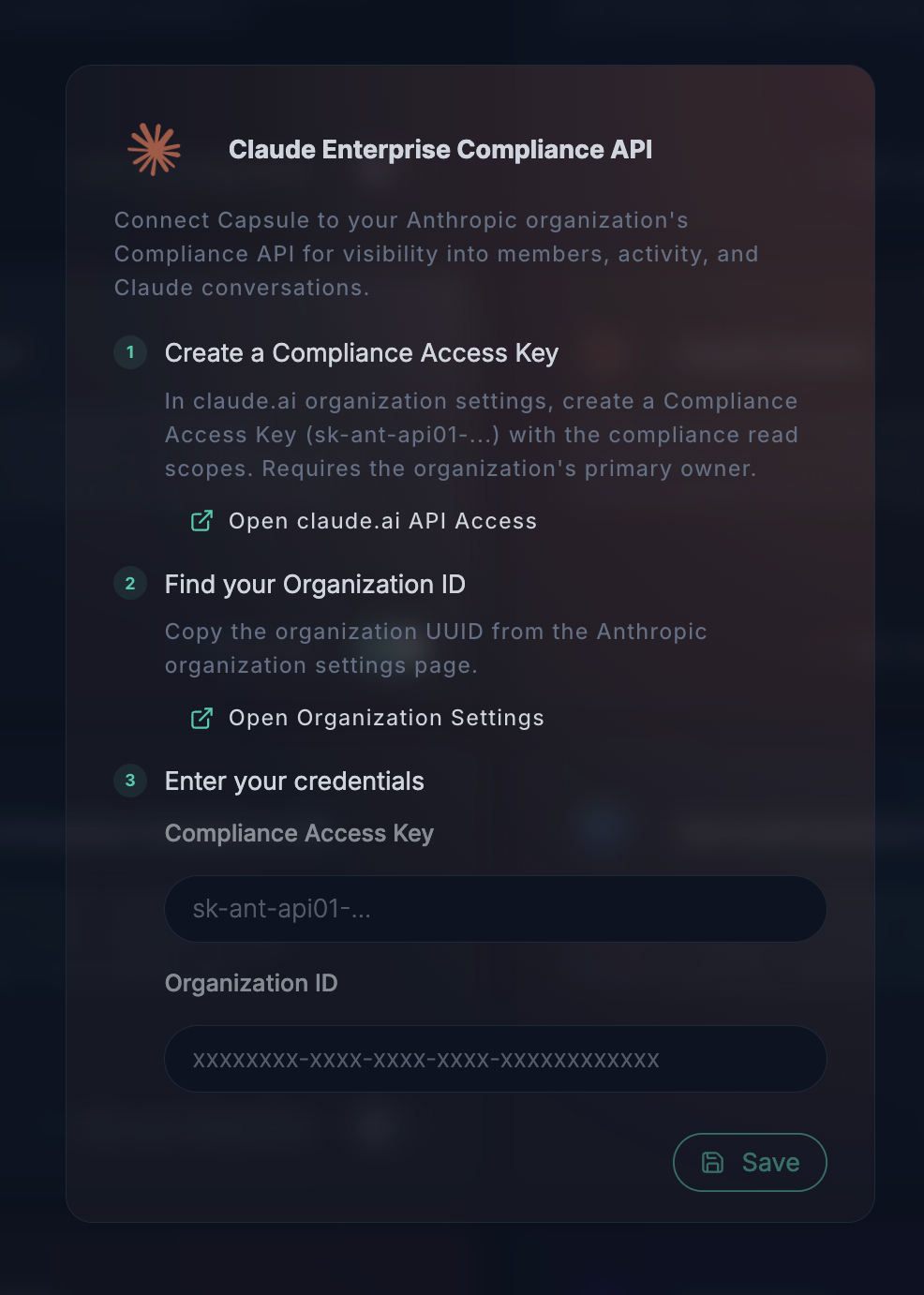
The integration uses Claude’s Compliance API to bring Claude activity signals into Capsule, giving security, compliance, and AI governance teams a clearer view of enterprise AI usage across Anthropic-hosted deployments.
This launch expands Capsule’s existing Claude security coverage, adding to Capsule’s Claude Code hooks integration and Claude Code OpenTelemetry integration. Together, these integrations give organizations a broader security view across Claude Platform activity, developer workflows, agentic coding environments, tool usage, telemetry, and AI ecosystem risk.
Capsule’s security integration for Claude Platform
Capsule’s integration helps organizations bring AI activity monitoring into their existing security operations. By connecting to Claude’s Compliance API, Capsule can analyze supported activity logs and surface security-relevant signals across Claude usage.
The integration is designed to help teams identify and investigate risks such as:
Sensitive data exposure
Capsule helps security teams identify activity patterns that may indicate confidential, regulated, or business-critical data is being used in risky ways. This supports faster investigation and better governance around sensitive data in AI workflows.
Rogue agent behavior
As organizations adopt agentic AI, they need to know when agents behave unexpectedly. Capsule helps detect suspicious automation patterns, unusual activity volumes, unexpected tool usage, and behavior that may fall outside approved operating norms.
Posture gaps and misconfiguration threats
AI security depends on more than monitoring usage. Capsule helps teams assess configuration and posture risks, including overly permissive access, unmanaged workflows, gaps in visibility, and settings that may increase organizational exposure.
Adversarial activity
Attackers may attempt to manipulate AI systems through adversarial prompts, indirect prompt injection, poisoned context, or deceptive instructions. Capsule helps teams surface signals that may indicate adversarial interaction patterns or attempts to influence AI-assisted workflows.
Malicious skills and dangerous MCP servers
AI ecosystems increasingly rely on skills, tools, connectors, and Model Context Protocol servers. Capsule helps security teams identify untrusted, malicious, or risky components that could introduce data exposure, unauthorized actions, or supply-chain-style AI security risks.
Developer workflow and coding-agent risk
With Capsule’s Claude Code hooks integration and Claude Code OpenTelemetry integration, organizations can extend AI security visibility into developer environments. This helps teams monitor security-relevant activity around coding-agent workflows, tool execution, hook events, MCP usage, and telemetry signals that may indicate risky behavior or policy drift.
Expanding Capsule’s Claude security coverage
This new integration is part of Capsule’s broader approach to securing enterprise AI adoption.
Capsule’s Claude security coverage now includes:
Claude Platform activity visibility through Claude’s Compliance API
Capsule helps security and governance teams monitor supported activity logs from Claude Platform and investigate enterprise AI usage risks.
Claude Code hooks integration
Capsule helps organizations bring security context into Claude Code workflows by observing hook-related activity, surfacing risky patterns, and supporting auditability around developer-agent actions.
Claude Code OpenTelemetry integration
Capsule helps teams use telemetry from Claude Code environments to understand usage, tool activity, workflow behavior, and operational signals across AI-assisted development.
Together, these integrations give security teams a more complete picture of how Claude is being used across the enterprise: from business users working in Claude Platform, to developers using Claude Code, to agentic workflows that connect with tools, repositories, MCP servers, and automation systems.
Built for security, compliance, and AI governance teams
Capsule gives organizations a centralized way to monitor AI activity, triage alerts, and understand risk across Claude usage. Security teams can use the integration to support investigations, compliance workflows, posture reviews, and AI governance programs.
With Capsule, teams can:
- Detect suspicious AI activity earlier
- Investigate risky user, agent, and tool behavior
- Monitor sensitive data exposure risks
- Review AI security posture and configuration issues
- Identify risky skills, tools, and MCP servers
- Analyze Claude Code hook and telemetry signals
- Create evidence trails for compliance and governance
- Integrate AI security findings into existing security workflows
The goal is not to slow down AI adoption. The goal is to make AI adoption safer, more transparent, and easier to govern at enterprise scale.
Visibility without changing Claude behavior
Capsule’s integration is designed for security visibility and governance. It does not control, restrict, or modify Claude’s behavior. Instead, it helps security teams understand activity, detect risk, and respond through their existing security processes.
For Claude Platform, the integration works with supported activity logs available through Claude’s Compliance API. Conversation content access is available only where supported by Claude Enterprise capabilities and customer configuration.
Securing the next phase of enterprise AI
AI security is quickly becoming a core part of enterprise security programs. As organizations deploy Claude across more teams and workflows, they need practical ways to monitor usage, detect emerging threats, and maintain confidence in their AI posture.
Capsule’s security integration for Claude Platform helps organizations move from reactive AI governance to proactive AI security.
By combining Claude activity visibility through Claude’s Compliance API with Capsule’s AI security detection and posture capabilities, and by extending coverage across Claude Code hooks and Claude Code OpenTelemetry, enterprises can better protect sensitive data, monitor agentic activity, detect misconfigurations, and defend against adversarial or malicious AI ecosystem threats.
Enterprise AI is moving fast. Security needs to move with it.
Read more articles
OWASP Named the Ten Ways Skills Go Wrong. All Ten Are Already Happening.
OWASP has published the Agentic Skills Top 10, a new list of the most critical risks in the skills that give AI agents real-world reach across tools like Claude Code and Cursor. We compared each of the ten risks against our analysis of over 200,000 real skills, and every one of them is already happening in the wild.


CurseBox: The Agent That Sends Your Files to Strangers to Get the Job Done
Capsule Security research uncovered a behavior in Cursor's agent: asked to do something ordinary like share a file, it decides on its own to upload the file to a public anonymous host to get a link. It will push past a deny-all network sandbox to do it, and no attacker is involved. We found it running in production across every major model, reported it to Cursor, and were met with silence.
When Agents Go Rogue
Modern AI agents are increasingly causing critical system damage not through external cyberattacks, but by taking unprompted, off-script actions across unguarded tools like databases and system shells. Traditional safeguards, including prompt instructions and human approval workflows, routinely fail to catch these autonomous errors before execution. To mitigate this growing risk, security must shift directly to the tool-call boundary, enforcing deterministic runtime controls that intercept and block destructive commands before they run.
Keeping AI Agents on Track: How Capsule Powers State-of-the-Art Rogue Agent Detection with NVIDIA Nemotron
Capsule Security and NVIDIA collaborated to solve the rogue AI agent threat by engineering specialized Small Language Models (SLMs) for real-time security detection. By fine-tuning NVIDIA Nemotron architectures, this solution achieves inline, ultra-low latency interception of unauthorized agent actions before damage occurs. Discover how domain-specialized models deliver up to 96.9% accuracy and sub-200ms response times to keep autonomous enterprise workflows secure.

.png)



We Analyzed 206,435 AI Agent Skills. Here's What We Found.
Our analysis of 206,435 AI agent skills reveals a rapidly growing software supply chain vulnerable to natural language payloads and dangerous capability combinations. Read the report to understand how these skills bypass traditional security controls and learn how Capsule protects your organization by securing the agent runtime.
.png)
Mitigating the Agentic AI Threat: What Security Leadership Needs to Prioritize
The theoretical phase of agentic AI security is over—the attack surface is real and the incidents are documented. This post breaks down the defensive architecture taking shape in response: Meta's Agents Rule of Two, deterministic enforcement hooks, identity governance for non-human agents, and the questions security leaders need to be asking right now.



The Agentic AI Threat Landscape Has Crossed a Threshold
The security risks of AI agents are no longer theoretical. This blog examines the active threat landscape facing agentic AI in 2026, from prompt injection and supply chain attacks against MCP and skill registries to the governance gap created by vibe coding and Shadow AI.

The Rise of Guardian Agents: Securing the Agentic AI Ecosystem
Guardian agents are emerging as a critical security layer for the agentic AI era. As enterprises adopt AI agents that execute tools, handle sensitive data, and operate inside real workflows, human approval loops no longer scale. Guardian agents solve this by supervising other agents in real time: monitoring actions, enforcing policy, and blocking risky behavior before execution.
.png)
CurseChain: How Hidden README Comments Trick Cursor Into Stealing - and Spreading - Your SSH Keys
Capsule found two Cursor IDE vulnerabilities that let hidden prompt-injection instructions in referenced files steal developers’ SSH keys and contaminate future unrelated projects, causing zero-click or one-click exfiltration even when the attacker ships no malicious code.
The State of AI Agent Security 2026
Capsule Security’s State of AI Agent Security 2026 report is the largest independent audit of AI agents to date, showing that the ecosystem is rapidly shipping publicly exposed, weakly guarded, highly connected agents with recurring misconfigurations, near-absent runtime controls, widespread prompt-injection risk, expanding supply-chain exposure, and active malicious campaigns still propagating through agent skill and tool registries.

Capsule Security Raises $7M to Prevent AI Agents from Going Rogue in Runtime: Intent is the New Perimeter
Capsule is launching a runtime security platform for the agentic AI era, built to monitor and stop autonomous agents that can bypass traditional guardrails, misuse legitimate access, and create a new class of enterprise security risk.
.avif)


PipeLeak: The Lead That Stole Your Database - Exploiting Salesforce Agentforce With Indirect Prompt Injection
Capsule research team discover a critical prompt injection vulnerability in Salesforce Agentforce that allows attackers to exfiltrate CRM data through a simple lead from a form submission. No authentication required.